

















10 Best AI Process Mining Tools in 2026: Ranked, Compared & Reviewed for Enterprise Optimization

An in-depth comparison of the leading AI-powered process mining platforms. Discover how intelligent process analytics can uncover hidden bottlenecks, predict outcomes, and drive measurable operational improvements across your organization.
Table of Contents
What Are AI Process Mining Tools?
AI process mining tools are advanced software platforms that use artificial intelligence and machine learning algorithms to analyze event logs from enterprise systems such as ERP, CRM, and BPM platforms. These tools automatically discover how business processes actually execute in real life, identify deviations from intended workflows, detect bottlenecks and inefficiencies, and provide actionable recommendations for optimization. Unlike traditional process analysis methods that rely on manual interviews and workshops, AI process mining tools extract objective, data-driven insights directly from the digital footprints that your business systems already generate every day.
The global process mining software market reached an estimated $0.85 billion in 2026, up from $0.72 billion in 2025, and is projected to grow significantly through 2031 as more enterprises recognize the value of data-driven process intelligence. According to industry research, 51% of large enterprises now actively use some form of process mining, and this adoption rate is accelerating as AI capabilities make these tools more powerful, accessible, and easier to implement. The integration of artificial intelligence into process mining represents a fundamental shift from descriptive analytics (showing what happened) to predictive and prescriptive analytics (forecasting what will happen and recommending what to do about it).
How AI Process Mining Works: The Three Pillars
AI process mining operates across three fundamental pillars, each enhanced by artificial intelligence to deliver deeper and more actionable insights than traditional process analysis methods could ever achieve. Understanding these three pillars is essential for evaluating and selecting the right tool for your organization.
Process Discovery (AI-Automated Model Generation): This is where AI process mining begins. Instead of manually mapping processes through interviews and workshops, the tool ingests event log data from your IT systems (SAP, Salesforce, Oracle, ServiceNow, etc.) and automatically constructs a visual process model that shows exactly how work flows through your organization. AI-enhanced discovery goes far beyond traditional discovery by using machine learning to identify process variants, cluster similar execution paths, handle incomplete or noisy data, and discover subprocesses that traditional algorithms might miss. Advanced AI discovery can even identify processes that were never formally documented, revealing shadow workflows that employees have created to work around system limitations.
Conformance Checking (AI-Powered Deviation Analysis): Once the as-is process model is discovered, AI tools compare it against the intended or documented process model to identify deviations. AI-enhanced conformance checking uses anomaly detection algorithms to flag unusual execution patterns, classify deviation types (intentional workarounds, compliance violations, system errors, or optimization opportunities), quantify the business impact of each deviation, and trace root causes back to specific departments, teams, or even individual transactions. This capability is particularly valuable for regulated industries where compliance adherence is critical.
Process Enhancement (AI-Driven Optimization Recommendations): The most valuable pillar for business leaders, AI-enhanced process enhancement uses predictive analytics, simulation, and machine learning to forecast future process performance, recommend specific changes to improve efficiency and reduce costs, predict the impact of proposed process changes before implementation, and continuously monitor process improvements in real-time. This transforms process mining from a diagnostic tool into a strategic decision-making platform.
Why AI Changes Everything About Process Mining
Traditional process mining tools have been available for over a decade, but the integration of AI represents a quantum leap in capability. Before AI, process mining was limited to analyzing structured event logs and producing static visualizations that required data scientists to interpret. AI changes this in several fundamental ways. First, natural language processing allows business users to ask questions about their processes in plain English and receive instant, accurate answers. Second, machine learning algorithms can analyze millions of process variants simultaneously, identifying patterns that would be impossible for humans to detect manually. Third, predictive AI can forecast process outcomes and alert teams to potential issues before they escalate into costly problems.
Generative AI has further accelerated this transformation. Tools like Celonis now offer Process Copilots powered by large language models that act as conversational assistants, allowing any business user to explore process data, create custom dashboards, and generate reports without technical expertise. According to Gartner, the process mining market is rapidly transitioning from standalone process mining platforms to comprehensive process intelligence platforms that combine mining, task mining, and AI-driven analytics into unified solutions.
Complete Comparison: 10 Best AI Process Mining Tools
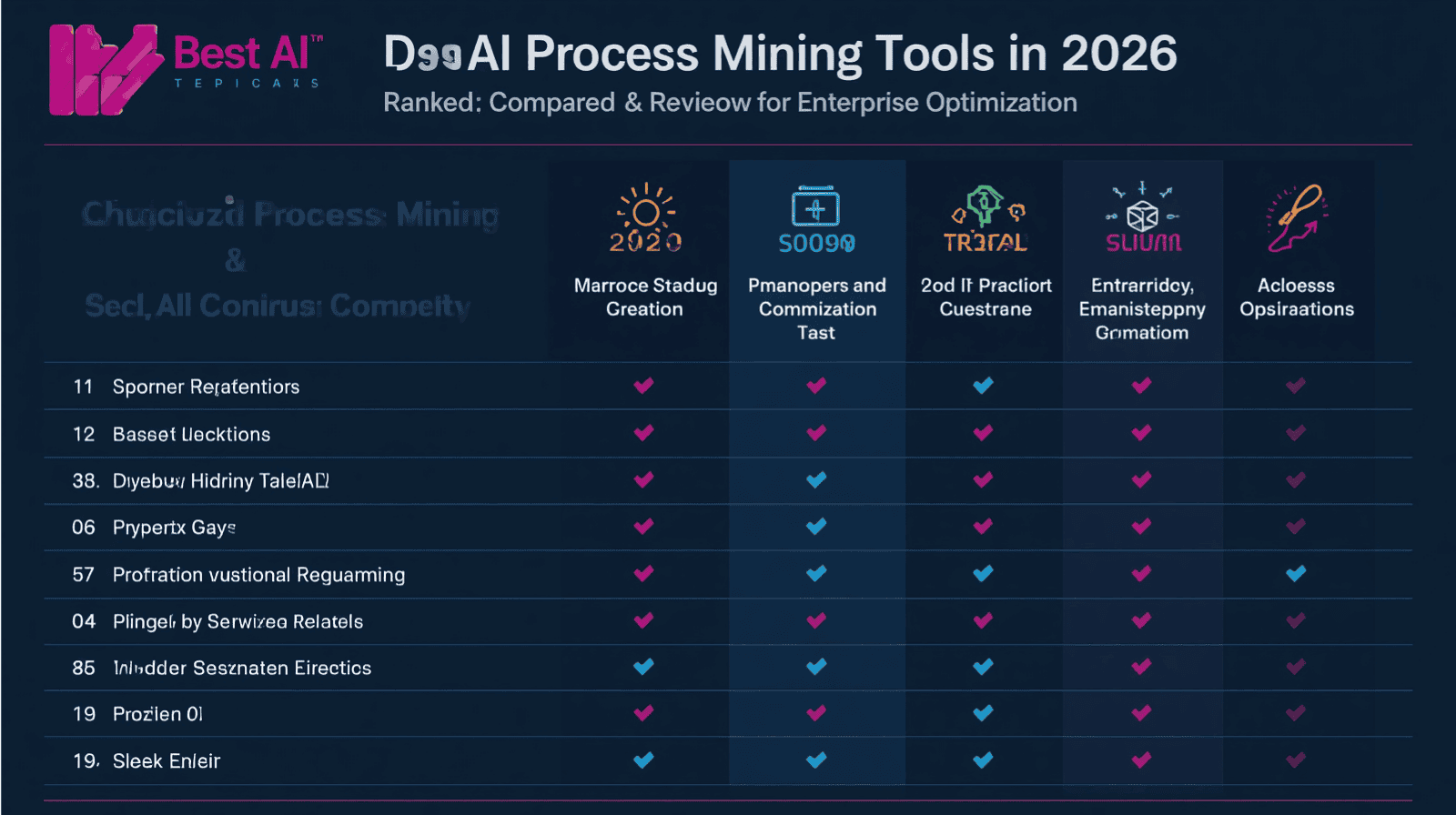
After extensive research and analysis of the leading platforms available in 2026, here is our comprehensive comparison of the ten best AI process mining tools. Each tool has been evaluated across multiple criteria including AI capabilities, deployment options, integration ecosystem, ease of use, pricing model, and ideal use case. The table below provides a quick-reference overview, followed by detailed reviews of each platform.
| Tool | Best For | AI Features | Pricing Model | Ideal Users |
| Celonis | Enterprise-wide optimization | Process Copilots, PI Graph, GenAI | Custom (enterprise) | Large enterprises 1000+ staff |
| UiPath | RPA + mining integration | AI-driven root cause, automation | Custom quote | Teams already using UiPath RPA |
| IBM Process Mining | Enterprise-scale analytics | ML anomaly detection, NLP insights | From $4,250/mo | Large orgs needing IBM integration |
| SAP Signavio | SAP ecosystem users | AI simulation, predictive analytics | Custom (SAP bundled) | Companies running SAP suite |
| Apromore | Open-source / academics | AI-enhanced discovery, filtering | Free + custom | Academics, mid-market, budget teams |
| Microsoft Process Mining | Microsoft 365 users | AI insights, Power BI integration | Included in license | Organizations using M365 ecosystem |
| ARIS (Software AG) | Business architecture | AI-powered process design, simulation | Custom quote | Enterprise architecture teams |
| ProcessMind | Mid-market simplicity | AI conformance, smart filtering | Custom (affordable) | SMBs, mid-market companies |
| Minit (Mirosoft) | Quick-win analytics | ML pattern detection, AI alerts | Custom quote | Teams wanting fast time-to-value |
| ABBYY Timeline | Document-heavy processes | AI OCR + process mining | Custom quote | Organizations with document workflows |
Detailed Reviews: Top 5 AI Process Mining Tools
1. Celonis Process Intelligence Platform
Celonis is the undisputed market leader in process mining and process intelligence, commanding the largest market share globally and serving over 2,000 enterprise customers including ABB, Siemens, Uber, and Vodafone. The Celonis Process Intelligence Platform goes beyond traditional process mining by combining process discovery, conformance checking, and enhancement with a proprietary data structure called the PI Graph, which creates a comprehensive digital twin of an organization’s entire process landscape in real-time.
What sets Celonis apart in 2026 is its aggressive integration of generative AI. The platform’s Process Copilots allow business users to interact with their process data conversationally using natural language queries. Instead of building complex queries or navigating dashboards, you can simply ask questions like “Show me the biggest bottlenecks in our procurement process this quarter” or “Which suppliers consistently cause delays in our supply chain?” and receive instant, data-driven answers with visualizations. The Celonis AI Development environment also enables organizations to build custom AI solutions on top of the Process Intelligence Platform, extending its capabilities for specific business needs.
Celonis integrates natively with over 300 enterprise systems including SAP, Oracle, Salesforce, ServiceNow, and Workday, providing out-of-the-box connectors that significantly reduce implementation time. The platform’s Action Engine can automatically trigger actions based on process insights, such as sending alerts when a process deviates from the optimal path, creating tickets for remediation, or even directly executing RPA bots to handle repetitive tasks. This closed-loop capability transforms process mining from an analytical tool into an operational automation platform. Pricing is enterprise-custom and typically starts in the six-figure range annually, making Celonis best suited for large organizations with 1,000+ employees and significant process optimization budgets.
2. UiPath Process Mining
UiPath Process Mining holds a unique position in the market because it is deeply integrated with the UiPath RPA (Robotic Process Automation) platform, creating a seamless pipeline from process discovery to automation implementation. The platform uses AI-powered machine learning algorithms to analyze event logs, discover actual process flows, identify automation opportunities, and prioritize them based on business impact and feasibility. This integration between mining and automation is UiPath’s primary competitive advantage.
The AI capabilities in UiPath Process Mining include automated root cause analysis that uses machine learning to identify the underlying reasons for process deviations, predictive analytics that forecast future process performance based on historical patterns, and intelligent alerting that proactively notifies teams when processes deviate from expected behavior. The platform also includes task mining capabilities that capture user interactions at the desktop level, providing visibility into manual work that event logs alone cannot capture. This combination of process mining and task mining gives organizations a complete picture of both system-driven and human-driven process steps.
UiPath Process Mining is particularly strong for organizations that have already invested in the UiPath ecosystem. The platform can automatically identify processes that are ideal candidates for RPA automation, calculate the ROI of automating each process, and even generate the initial automation blueprints that RPA developers can use to build bots. This end-to-end capability, from process understanding through automation implementation and monitoring, creates a compelling value proposition for organizations looking to maximize their RPA investments. Pricing is typically bundled with UiPath platform licenses and varies based on the scope and scale of deployment.
3. IBM Process Mining
IBM Process Mining brings enterprise-grade scalability and AI sophistication to the process intelligence market, leveraging IBM’s decades of expertise in data analytics, machine learning, and enterprise software. The platform uses advanced AI algorithms including natural language processing, anomaly detection, and predictive modeling to analyze process data from across the enterprise and deliver insights that are both actionable and enterprise-ready. IBM Process Mining starts at approximately $4,250 per month through IBM Cloud Pak for Business Automation SaaS, positioning it as a premium but more transparently priced option compared to some competitors.
The platform’s AI capabilities include automated business rule discovery that uses machine learning to identify the implicit rules governing process execution, advanced conformance checking that can handle complex, multi-layered process models with thousands of variants, and AI-powered root cause analysis that traces process issues to their systemic causes rather than just identifying symptoms. IBM Process Mining also excels in scalability, capable of processing billions of event records in real-time across complex, multi-system processes that span entire enterprise value chains.
A key advantage of IBM Process Mining is its integration with the broader IBM ecosystem, including Watson AI, Maximo, Turbonomic, and the Cloud Pak platform. This allows organizations to embed process intelligence into existing IBM-based workflows and leverage Watson’s AI capabilities for advanced analytics. The platform is particularly well-suited for large organizations that operate in regulated industries (banking, healthcare, insurance) where compliance monitoring, audit readiness, and enterprise scalability are critical requirements.
4. SAP Signavio Process Intelligence
SAP Signavio is the natural choice for organizations that operate on the SAP ecosystem, offering deeply integrated process mining that leverages SAP’s unparalleled access to enterprise transaction data. The platform combines process mining, process modeling, process simulation, and process analytics into a unified cloud-based solution that provides end-to-end visibility into business processes. SAP Signavio’s AI capabilities include predictive process analytics that forecast future process performance, AI-powered simulation that models the impact of proposed changes before implementation, and intelligent process recommendations that suggest optimizations based on industry benchmarks and best practices.
What makes SAP Signavio particularly compelling is its ability to combine process mining data with process modeling data. While most process mining tools only show how processes actually execute, Signavio can overlay the as-is (discovered) process model with the to-be (designed) process model, allowing organizations to see exactly where reality diverges from design and take corrective action. The platform’s collaboration features allow distributed teams to jointly analyze process data, share insights, and co-create process improvements, which is valuable for large organizations with multiple business units and geographic locations.
SAP Signavio’s pricing is typically bundled with SAP transformation and process management packages, which makes it difficult to provide standalone pricing. However, for organizations already using SAP S/4HANA, SAP Ariba, SAP Concur, or other SAP solutions, Signavio offers the most seamless and deeply integrated process mining experience available. The platform’s AI simulation capabilities are especially valuable for organizations planning digital transformation initiatives, as they can model the expected impact of changes before committing resources to implementation.
5. Apromore (Open-Source Leader)
Apromore stands out as the leading open-source process mining platform, developed by researchers at the University of Melbourne and maintained by a global community of academics and practitioners. This open-source foundation gives Apromore several unique advantages: complete transparency into the algorithms used for process discovery and analysis, no vendor lock-in since organizations can modify and extend the platform freely, a significantly lower total cost of ownership compared to enterprise alternatives, and a strong academic research community that continuously advances the state of the art in process mining algorithms.
Despite being open-source, Apromore offers robust AI-enhanced features including intelligent process filtering that uses machine learning to help users focus on the most relevant process subsets, automated process comparison that identifies differences between process executions across time periods, departments, or customer segments, and AI-powered anomaly detection that flags unusual patterns for investigation. The platform supports all three types of process mining (discovery, conformance, and enhancement) and provides interactive visualizations that make complex process data accessible to non-technical stakeholders.
Apromore is an excellent choice for academic institutions, mid-market organizations with limited budgets, and teams that want to experiment with process mining before committing to an enterprise platform. The free open-source version provides substantial functionality, while commercial support and enterprise features are available through Apromore’s commercial partners. For organizations that need advanced AI features, enterprise-grade scalability, or seamless integration with specific enterprise systems, commercial alternatives like Celonis or IBM may be more appropriate, but Apromore remains the best entry point for teams exploring process mining for the first time.
AI Process Mining Use Cases: Real-World Impact

AI process mining tools deliver measurable business value across virtually every industry and functional area. According to industry research, organizations implementing AI process mining report average cost reductions of 15-25%, cycle time improvements of 30-50%, and compliance violation reductions of 60-80%. Here are the most impactful use cases where AI process mining tools deliver the highest ROI in 2026.
Procure-to-Pay Optimization
The procure-to-pay (P2P) process is one of the most common and highest-ROI applications for AI process mining. Organizations typically discover that their actual P2P process contains 10-20x more variants than expected, with significant deviations from standard procedures that create compliance risks, increase processing costs, and extend payment cycle times. AI process mining tools analyze purchase requisition data, approval workflows, invoice processing events, and payment records to identify bottlenecks in approval chains, detect maverick spending patterns that bypass preferred vendors, flag duplicate invoices and payment fraud risks, and recommend process standardization opportunities. Companies using AI process mining for P2P optimization report average savings of 15-20% on procurement costs and 40-60% reduction in payment cycle times.
Order-to-Cash Automation
The order-to-cash (O2C) process directly impacts revenue recognition, customer satisfaction, and cash flow. AI process mining tools analyze the complete lifecycle from order receipt through fulfillment, invoicing, and payment collection to identify the root causes of order delays, predict which orders are most likely to experience fulfillment issues, detect billing errors and revenue leakage, and optimize credit management and collections processes. AI-enhanced tools can forecast cash flow timing based on historical payment patterns, allowing finance teams to make more accurate working capital decisions. Organizations implementing AI process mining for O2C report average working capital improvements of 10-15% and customer satisfaction increases of 20-30%.
Customer Service and Support Optimization
AI process mining transforms customer service operations by analyzing every customer interaction from first contact through resolution. The tools discover the actual paths customers take through support processes, identify the most common reasons for escalations and transfers, measure the true cost-to-serve for different customer segments, and predict which customers are at risk of churn based on their service experience patterns. AI-enhanced process mining can also analyze chatbot and IVR interaction logs alongside human agent event logs, providing a unified view of the entire customer service process regardless of channel. Organizations report 25-35% reductions in average handle time and 15-20% improvements in first-contact resolution rates after implementing AI process mining for customer service optimization.
IT Service Management and IT Modernization
AI process mining is increasingly critical for IT modernization initiatives, where organizations need to understand their current IT service delivery processes before migrating to new platforms or implementing changes. The tools analyze ITSM event logs from ServiceNow, Jira, BMC Remedy, and similar platforms to discover the actual IT service delivery workflows, identify automation opportunities for IT processes, measure the impact of IT changes on business processes, and monitor IT service compliance with SLAs and ITIL standards. Celonis specifically positions its platform for enterprise IT modernization use cases, claiming that organizations can reduce IT migration risks by up to 50% through process intelligence-driven planning.
ROI and Business Impact: By the Numbers
Understanding the return on investment of AI process mining tools is critical for building the business case and securing executive buy-in. Based on aggregated data from industry reports, vendor case studies, and analyst research, here are the quantifiable benefits that organizations typically achieve through AI process mining implementation.
| Metric | Before AI Mining | After AI Mining | Improvement |
| Process Efficiency | 45-55% | 70-85% | 25-40% improvement |
| Cost per Transaction | $12-$18 | $6-$10 | 35-50% reduction |
| Cycle Time (Procurement) | 14-21 days | 5-9 days | 40-60% faster |
| Compliance Violations | 8-15% | 2-5% | 60-80% reduction |
| Process Variant Explosion | 50-100+ variants | 5-15 variants | 70-90% standardization |
| Time to Identify Root Cause | 2-4 weeks | Hours to days | 85-95% faster |
| Automation Opportunity ID | 3-6 months | 2-4 weeks | 75-85% faster |
Table 2: Average ROI metrics from AI process mining implementation across industries.
The process mining software market is projected to grow from $0.85 billion in 2026 to over $1.5 billion by 2031, reflecting increasing enterprise adoption driven by the demonstrated ROI of these tools. Gartner predicts that by 2028, 60% of large enterprises will use process intelligence platforms as a core component of their digital transformation strategy, up from approximately 35% in 2024.
How to Choose the Right AI Process Mining Tool
Selecting the right AI process mining tool requires careful evaluation of your organization’s specific needs, existing technology stack, budget constraints, and strategic objectives. The market offers solutions ranging from free open-source platforms to enterprise-grade platforms costing six figures annually, and the best choice depends entirely on your context. Here is a structured decision framework to guide your evaluation.
Step 1: Define Your Primary Objective
Before evaluating any tool, clearly define what you want to achieve with process mining. Common objectives include reducing operational costs in a specific process, improving compliance with regulatory requirements, identifying and prioritizing automation opportunities, supporting a digital transformation or IT migration initiative, or gaining real-time visibility into cross-functional processes. Your primary objective will significantly narrow the field of suitable tools. For cost reduction in a specific process, almost any tool will work. For enterprise-wide transformation, you need a platform like Celonis or SAP Signavio with the scalability and integration depth to handle complex, cross-system analysis.
Step 2: Assess Your Data Sources and Systems
Process mining is only as good as the data it analyzes. Make a comprehensive inventory of the enterprise systems that contain process event logs relevant to your objectives. Common data sources include ERP systems (SAP, Oracle, Microsoft Dynamics), CRM platforms (Salesforce, HubSpot, Microsoft Dynamics 365), ITSM tools (ServiceNow, Jira, BMC Remedy), HR platforms (Workday, SuccessFactors), and custom applications with accessible databases or APIs. The tool you choose must support connectors to your specific data sources, or you must be prepared to invest in custom data extraction and transformation. Apromore and other open-source tools may require more manual data preparation, while enterprise platforms like Celonis and IBM offer pre-built connectors that dramatically reduce implementation effort.
Step 3: Evaluate AI Capabilities
Not all AI process mining tools are created equal. When evaluating AI capabilities, focus on three key areas: the sophistication of process discovery algorithms (can they handle noisy data, millions of variants, and cross-system processes?), the quality of predictive analytics (can they forecast process outcomes with meaningful accuracy?), and the accessibility of AI features (can non-technical business users leverage AI insights, or is a data science team required?). Ask vendors for specific demos using your own data rather than relying on polished marketing presentations. Request access to trial environments and test with realistic data volumes that reflect your actual process complexity.
Step 4: Consider Total Cost of Ownership
The true cost of an AI process mining tool extends far beyond the license fee. Consider implementation costs (consulting, data engineering, customization), ongoing operational costs (data infrastructure, maintenance, support), training and change management costs, and opportunity costs of the time your team invests. Enterprise tools like Celonis and IBM Process Mining may have higher upfront costs but lower long-term operational costs due to their mature ecosystems, extensive documentation, and large partner networks. Open-source tools like Apromore have near-zero licensing costs but may require significantly more internal expertise and custom development.
Frequently Asked Questions
What is the difference between process mining and task mining?
Process mining analyzes event logs from IT systems to discover how business processes execute at a system level. It shows the flow of work between systems, departments, and process steps. Task mining, on the other hand, captures user interactions at the desktop level, including mouse clicks, keystrokes, and screen transitions, to understand how individual employees perform their work within each process step. Task mining reveals the human layer of process execution that system event logs cannot capture, such as manual data entry, copy-paste operations, and application switching. The most comprehensive platforms like UiPath and KYP.ai combine both process mining and task mining for end-to-end process visibility.
Is AI process mining suitable for small businesses?
Yes, but the approach differs from enterprise deployments. Small businesses should start with Apromore (free open-source) or Microsoft Power Automate Process Mining (included in existing Microsoft licenses) to minimize costs. Focus on one or two high-impact processes initially, such as order fulfillment or customer onboarding, rather than attempting enterprise-wide analysis. The free tiers and open-source options provide substantial functionality that is more than sufficient for the process complexity typical of small and mid-market organizations. As the organization grows and process complexity increases, migration to a more feature-rich commercial platform is straightforward since the fundamental concepts and data structures are consistent across all tools.
How long does it take to implement AI process mining?
Implementation timelines vary significantly based on tool selection, data readiness, and scope. With a cloud-based tool like Celonis and clean data sources, initial results can be achieved in 2-4 weeks for a single process. A comprehensive enterprise-wide deployment across multiple processes typically takes 3-6 months. Open-source tools may require additional time for data preparation and infrastructure setup, potentially extending the timeline by 2-4 weeks. The key factor that determines implementation speed is data quality and availability, not the tool itself. Organizations with well-maintained enterprise systems and accessible event logs can achieve results significantly faster than those with fragmented, inconsistent, or poorly documented data sources.
What data is needed for AI process mining?
AI process mining tools require event log data, which consists of three core components: a unique case identifier (e.g., order ID, ticket number, or customer ID), an activity name (e.g., “Invoice Created,” “Approval Requested,” or “Payment Sent”), and a timestamp for each activity. Additional attributes such as resource information (who performed the activity), data values (amounts, categories, locations), and system identifiers enrich the analysis and enable more sophisticated AI insights. Most enterprise systems already generate this data as part of their standard audit logging, but extracting, transforming, and loading it into the process mining platform is often the most time-consuming part of the implementation.
Can AI process mining replace process modeling tools like Visio or Lucidchart?
AI process mining complements but does not fully replace process modeling tools. Process mining discovers how processes actually execute based on real data, while process modeling tools are used to design how processes should execute. The most effective approach combines both: use AI process mining to discover the current state, use modeling tools to design the target state, and use process mining’s conformance checking to measure and monitor the gap between current and target. Platforms like SAP Signavio and ARIS combine both mining and modeling in a single platform, providing a seamless workflow from discovery through design to implementation and monitoring.
Also Read:
15+ Best Make.com AI Automation Templates

Best AI SEO Tools in 2026: Top AI SEO Software for Rankings, Tracking and Analysis

Best AI SEO Tools & Agencies in 2026: The Ultimate Guide to AI-Powered Search Dominance

Sora Shutting Down? OpenAI Confirms Sora App Shutdown — What’s Really Happening in 2026

Automate YouTube with N8N

What Are AI Search Optimization Tools? Complete Guide (2026)

Make YouTube Videos with AI Free (2026 Guide for Beginners)

🧠 Can AI Content Rank on Google in 2026? (Real Answer for Creators)

🧠 Best AI Tools for Content Creators in 2026 (Complete Guide)

